Dog Life Simulator
- 4.4
- Rating
- 10.00M
- Installs
- Free
- Price

 Analysis by App-foxy
I approached Dog Life Simulator expecting a light role-playing game built around the appeal of seeing ordinary situations from a dog’s point of view. That is exactly where its charm lies. It is not trying to be a serious animal-care simulation or a demanding strategy game; instead, it turns canine behavior and everyday choices into a playful series of decisions. I found it easiest to enjoy when I treated it as a relaxed, humorous experience rather than a game with a highly complex rule system.
That distinction matters before you download it. The game is free, belongs to the role-playing category, and comes from Funcell Games Pvt Ltd. It has reached more than ten million installs and holds a 4.5 average from roughly sixty-eight thousand ratings, which suggests that its simple premise connects with a large audience. The age rating is Teen, so parents should still check whether its style and scenarios suit younger players. On compatible devices, it requires Android 7.0 or later, and the current version is 5.9.5.
How the dog-centered decisions shape each session
I find the dog-centered decisions work best when I treat each session as a small experiment in personality, rather than trying to force every choice toward one ideal outcome. That approach keeps the humor intact and gives me a reason to notice how the game frames a situation before I react. It also sets up a useful question for returning players: how much does this simple loop continue to reward after its premise feels familiar?
You May Also Like

 Blood Strike: 2.5 Anniversary
Blood Strike’s Loadouts Turn Every Drop Into a Tactical Gamble
A close look at Blood Strike’s custom loadouts: how fast access to signature weapons reshapes its battle royale rhythm, rewards preparation, and narrows the gap between fights.

 Pandora - Music & Podcasts
Pandora’s Music Is Easy to Start, but Harder to Recover
Pandora’s strength is its low-effort path from a seed to a station. Its weak spot is how much confidence it asks you to place in connection, setup, and quiet recovery.

 8 Ball Pool
 Is Built on Rivalries, Rematches, and Routine
A close look at the rivalries, rematches, shared routines, and unanswered safety questions that turn a quick pool match into a persistent mobile community.

 Samsung Music
’s Quiet Strength Is Playing What You Already Own
Its reach comes less from spectacle than from dependable access to a personal library. That simplicity is both the app’s strongest retention engine and its ceiling.

 AccuWeather: Weather Radar
AccuWeather Review: A Quick, Clear Forecast for Everyday Decisions
For everyday plans, the best forecast is the one you can understand quickly. AccuWeather makes rain timing, radar, and local conditions easy to act on, with a few trade-offs.

 Hill Climb Racing
Why Hill Climb Racing Still Turns Crashes Into One More Run
A tiny car, a bumpy hill and one more upgrade: Hill Climb Racing keeps resurfacing because its simple chaos makes every near-miss feel personal.
More From Our News Desk



Small choices make the role-playing feel personal
The central appeal is the viewpoint. Rather than controlling a conventional hero with weapons, quests, or a fantasy class, I make decisions as a dog moving through situations that are familiar enough to understand but exaggerated enough to be entertaining. That change in perspective gives ordinary actions a different meaning. A choice that might seem harmless to a person can feel like an opportunity, a temptation, or a risk when viewed through a dog’s instincts.
I liked that the game does not require a long explanation before it becomes understandable. The basic loop is approachable, which makes it suitable for short sessions. I could open it when I had a few spare minutes, make progress, and stop without needing to remember a complicated control scheme. That accessibility is one of its strongest qualities, especially for players who enjoy character-driven mobile games but do not want a dense interface.
There is still a useful decision layer beneath the playful presentation. I found myself weighing immediate amusement against the possibility of creating a less favorable outcome. The choices are not interesting because they demand advanced calculations; they are interesting because they encourage me to imagine what a dog would do and then accept the result. That makes the game feel closer to interactive storytelling than to a traditional statistics-heavy role-playing adventure.
Planning helps more than rushing
One of the better ways to approach the game is to pause briefly before selecting an option. My first instinct was often to choose the funniest or most mischievous response, but that was not always the most satisfying route. When I considered the situation from the dog’s perspective, I could make a more deliberate choice instead of simply tapping through the first amusing possibility.
This creates a modest but worthwhile planning horizon. In a short session, I might focus on getting through the current situation. Over several sessions, I began thinking about whether I wanted to follow a consistently well-behaved personality, lean into chaos, or simply explore different reactions. That kind of self-imposed direction gives the experience more identity, even when the game itself remains easy to pick up.
A practical tip is to avoid treating every scene as a race. Read the wording carefully, consider the likely tone of the response, and choose according to the kind of dog you want to play. This is especially useful for players who enjoy role-playing through personality rather than optimizing a character build. The game rewards attention to context more than complicated preparation.
Where it differs from ordinary role-playing games
Compared with the usual alternatives in the role-playing category, this is much lighter. A conventional role-playing game may emphasize combat rotations, equipment, character statistics, large maps, or long quest chains. Dog Life Simulator is better understood as a compact character fantasy. Its pleasure comes from inhabiting an unusual role and seeing how that role changes the meaning of familiar events.
That makes it a good alternative for someone who likes role-playing choices but does not want to spend an hour managing a party or learning a large system. It is also more approachable than many combat-focused games for players who prefer humor and quick decisions. On the other hand, anyone looking for deep world-building, tactical battles, or a long-form adventure should choose a different type of role-playing game. The dog theme is the main attraction, not a wrapper around a conventional epic.
Using the game in an everyday routine
I can easily imagine playing this during a commute, while waiting for an appointment, or in the evening when I want something more interactive than scrolling but less demanding than a full game session. A useful routine is to play a few scenes, stop at a natural point, and return later with a clear idea of which personality or approach you want to try next.
It also works as a casual conversation game between friends or family members who like animals. One person can suggest what a dog would do, while another chooses the option they think fits best. That does not transform it into a multiplayer experience, but it does make the decision-making more social. The appeal comes from comparing interpretations of the same canine situation.
For a dog owner, the premise may feel especially recognizable, although the game should not be treated as a guide to real animal behavior. Its situations are designed for entertainment. I enjoyed the familiar emotional cues, but I would not use the game to teach a child how to train or care for a real dog. It captures the fantasy of canine perspective, not the responsibilities of pet ownership.
Reward, risk, and the temptation to spend
The free entry point is helpful because it lets curious players test the concept without committing money first. In-app purchases range from ninety-nine cents to seven dollars and ninety-nine cents per item. I would recommend deciding on a personal spending limit before playing, particularly if you are the kind of player who makes impulse purchases to keep a session moving.
The important trade-off is not simply whether a purchase is affordable. It is whether spending improves the part of the game you actually enjoy. If your main interest is exploring the dog’s personality and seeing different outcomes, patience may be more valuable than buying immediately. If you prefer a smoother, less interrupted session, optional purchases may feel more attractive, but they can also reduce the satisfaction of working through the experience at your own pace.
My approach was to play the free portion first and decide whether the basic loop remained enjoyable after the novelty of the premise faded. That is a better test than judging the game from its animal theme alone. A cute concept can be appealing for a few minutes, but the real question is whether you enjoy making the choices repeatedly. If the answer is no, spending will not solve the underlying problem.
There is also a risk-and-reward decision inside the game itself. Mischievous actions can be more entertaining because they create stronger reactions, while safer choices may better match a player who wants a calmer or more responsible dog personality. I found that the most satisfying route was not always the one with the most dramatic result. Sometimes the reward was simply seeing a choice fit the character I had decided to play.
Adapting instead of repeating the same response
The game becomes more interesting when I use each outcome as feedback. If a choice produces a result I do not like, I can treat that as information about the tone of the situation rather than as a failure. This encourages experimentation. Instead of repeating the same type of answer, I can change my approach and see whether a more cautious, curious, or mischievous response feels better.
That adaptation is particularly useful for players who enjoy discovering personality through action. I recommend keeping a loose mental note of the choices that seem to create the most entertaining consequences. There is no need to turn the game into a spreadsheet; simply remembering which style you have been following can make later decisions feel more intentional.
A second useful tactic is to separate exploration from commitment. On an initial run, I would choose the response that feels most natural and observe how the game frames the result. On a later run, I would deliberately choose the opposite style. This gives the game more replay value than tapping randomly, because each session has a clear purpose.
The limitation is that this adaptation remains relatively light compared with role-playing games built around branching campaigns or highly developed character systems. Players expecting every decision to create a major long-term transformation may find the consequences less substantial than they hoped. The game is better at delivering amusing or engaging moments than at building a deeply interconnected simulation.
How the experience holds up over time
Dog Life Simulator is strongest during the early period when the viewpoint feels fresh and I am curious about how different choices will be interpreted. Its long-term appeal depends on whether I enjoy repeating the basic decision-making loop and shaping different versions of the dog character. That makes it a good fit for casual players who like bite-sized role-playing, but a less convincing choice for people who need constant mechanical progression.
I would describe its depth as expressive rather than technical. The game gives me room to decide what kind of dog I want to imagine, but it does not ask me to master a complex combat system or plan a detailed build. That can be a virtue when I want relaxation. It can also become a weakness if I am looking for a game that continually introduces new strategic layers.
To keep the experience from becoming repetitive, I would set small personal challenges. I might try to play as a consistently gentle dog, then attempt a more rebellious personality, or make choices based on curiosity rather than convenience. These self-directed goals are not a replacement for deeper mechanics, but they make the existing decisions feel more purposeful.
The game is also easier to return to than a large role-playing title because it does not demand the same level of memory or preparation. I do not need to reconstruct a complicated plot or remember the exact abilities of several characters. That makes it convenient for irregular play. If I skip a few days, returning feels straightforward rather than intimidating.
Who should try it, and who should skip it
I would recommend this game to animal lovers, casual role-playing fans, and players who enjoy making quick narrative choices. It is particularly suitable for someone who wants a playful change from fighting games and fantasy adventures. The dog perspective gives it a specific identity, and the free price makes it easy to sample.
It may also suit parents or older children who want a simple game to discuss together, although the Teen content rating means adults should make the final suitability decision. The game can prompt conversations about why a certain action feels kind, mischievous, selfish, or sensible, even though it should not be confused with a lesson in real-world pet care.
I would skip it if your priority is deep strategy, competitive play, realistic simulation, or a large role-playing world. Players who dislike repeated choice-based scenes may also lose interest once the novelty of the premise wears off. In those cases, a conventional adventure or a systems-focused role-playing game would offer more satisfying long-term goals.
Device expectations and practical setup
Android users with version 7.0 or newer can install the game, and the current release is 5.9.5. Before starting, I would make sure the device has enough free space for a comfortable installation and that notifications or interruptions will not break the short-session rhythm. Those are simple steps, but they matter when the appeal depends on staying engaged with a sequence of choices.
I also recommend approaching the game with realistic expectations about its free model. Start without purchasing anything, learn whether the core loop suits you, and only then consider whether an optional item is worth the cost. Since individual purchases can reach seven dollars and ninety-nine cents, a little restraint is useful for anyone sharing a device or allowing younger players to access the game.
My strategy verdict
My final view is that Dog Life Simulator succeeds because it commits to a clear, unusual fantasy: making everyday decisions through a dog’s eyes. It does not need the scale of a traditional role-playing epic to be enjoyable. Its best moments come from interpreting situations, choosing a personality, and accepting the consequences with a sense of humor.
The trade-off is equally clear. The game offers approachable role-playing and easy short sessions, but it is not designed for players who want elaborate systems or demanding strategy. Its long-term value comes from experimenting with different canine personalities rather than mastering a deep progression structure.
The smartest way to play is to treat each run as a personality experiment, not a race toward the most dramatic outcome. Play freely first, adapt after seeing how choices land, and use the free experience to decide whether the loop has enough variety for you. For animal lovers and casual players, that can be a genuinely pleasant way to fill spare moments. For serious role-playing fans, it is best viewed as a light side game rather than a replacement for a full-scale adventure.
Funcell Games Pvt Ltd has built something easy to understand and easy to recommend selectively. I would suggest giving it a try if the idea of interpreting the world as a dog sounds entertaining. Just remember that its strength is charm, perspective, and quick decision-making—not complex strategy, realism, or an enormous campaign.
FAQs for Dog Life Simulator
01What is the main objective of Dog Life Simulator?
Dog Life Simulator allows players to experience life from a dog's perspective. Your main objective is to navigate various challenges and adventures, making choices that affect your dog's happiness and life outcomes. Whether you're playing fetch, exploring new environments, or interacting with other animals, each decision shapes your dog's story.
02Is Dog Life Simulator suitable for all ages?
Dog Life Simulator is designed to be a fun and engaging game for a wide audience, including children and adults. However, it is recommended to check the app's age rating on the app store to ensure it aligns with your preferences. The game typically features family-friendly content, making it generally suitable for all ages.
03Does Dog Life Simulator require an internet connection to play?
While Dog Life Simulator can be played offline, certain features might require an internet connection. For example, accessing updates, downloading additional content, or participating in online events may need connectivity. It's best to check the app's specifications on the download page for detailed requirements.
04Are there in-app purchases in Dog Life Simulator?
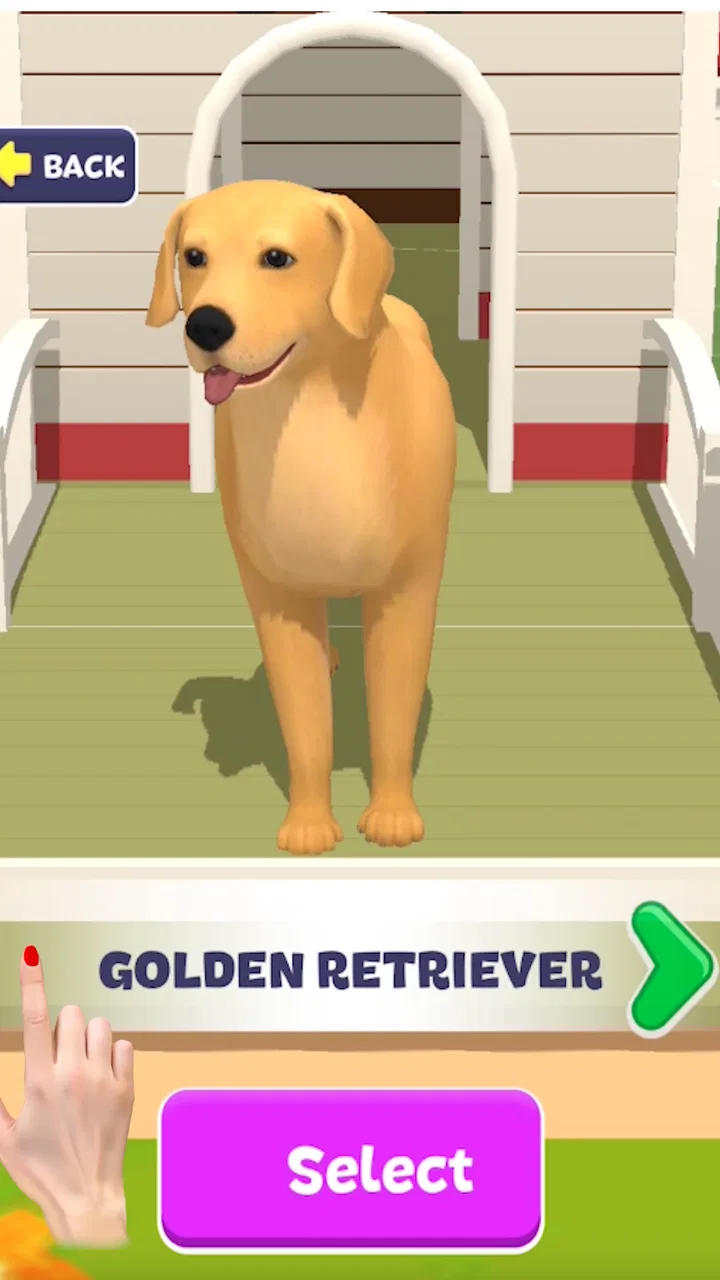
Yes, Dog Life Simulator offers in-app purchases. These typically include items such as special accessories, additional levels, or unique dog breeds. While the game can be enjoyed without spending money, in-app purchases can enhance the experience by providing customization and new opportunities.
05How can I report a bug or issue with Dog Life Simulator?
If you encounter any bugs or issues while playing Dog Life Simulator, you can usually report them through the app's support or feedback feature. Additionally, visiting the developer's website or app store page may provide contact information or a help center for addressing any concerns or technical problems.
Pros
- Engaging gameplay with realistic dog behaviors.
- Wide variety of breeds to choose from.
- Regular updates with new features.
- User-friendly interface and controls.
- Interactive environments to explore.
Cons
- In-app purchases can be costly.
- Some levels may feel repetitive.
- Occasional lag on older devices.
- Limited customization options.
- Ads can be intrusive at times.

Dog Life Simulator
Gallery